Stargazing in Egypt: Dark Desert Skies and the Astronomy of the Pharaohs
Where to see Egypt's darkest night skies, which temples and tombs show how the ancient Egyptians read the stars, and how to plan around the moon.
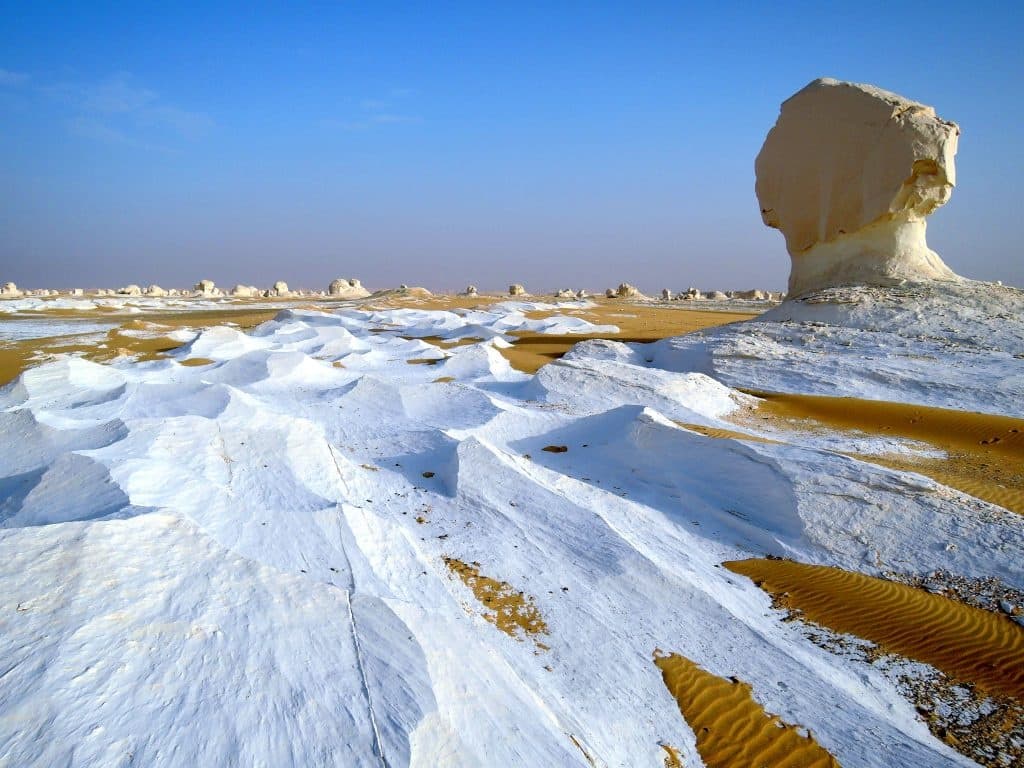
Away from the cities, Egypt has some of the clearest night skies many travelers will ever see. The deserts are dry, the air is still, and once you leave the Nile Valley there are very few lights on the horizon.
The sky also mattered deeply to the people who built the temples. The ancient Egyptians tracked the stars to keep their calendar, aligned buildings with the sun and painted the heavens on tomb ceilings. This guide covers both sides: where to go for a dark sky, and where to see ancient astronomy with your own eyes. It is about astronomy and history, not astrology or fortune-telling.
Where are the darkest skies in Egypt?
The best places share three things: distance from towns, dry air and somewhere safe and comfortable to spend the night. All of the places below are best visited with a licensed operator and a local driver who knows the area.
The White Desert and Bahariya. The chalk-white rock formations of the White Desert, in the Western Desert between Bahariya and Farafra oases, are one of Egypt's best-known places to camp under the stars. Most visitors drive out from Cairo to Bahariya, then continue into the desert by 4x4 and sleep in a simple camp. On a moonless night the pale rocks stand out against a sky full of stars.
Siwa and the Great Sand Sea. Siwa is a remote oasis near the Libyan border, known for its palm groves, springs and salt lakes. From Siwa, 4x4 trips go out into the dunes of the Great Sand Sea, where you can camp far from any lights. Entering the Sand Sea needs a national park permit, which your operator arranges. Siwa is reached by road from Marsa Matrouh on the Mediterranean coast.
Wadi El Hitan in Fayoum. The Valley of the Whales is a UNESCO World Heritage Site famous for fossil whales around 40 million years old. It has also become a popular place for overnight stargazing, with permitted tent camps, simple facilities and, at some camps, a telescope and a short talk about the planets. It is the easiest dark-sky trip from Cairo.
Sinai. The night climb of Mount Sinai, timed to reach the summit for sunrise, takes you up the mountain under the stars, and St Catherine's Monastery sits at its foot. The desert near Dahab is also used for evening stargazing trips. Some parts of Sinai carry government travel warnings, so check the current advice for your country before choosing a location here.
Marsa Alam and Wadi El Gemal. On the southern Red Sea coast, Wadi El Gemal National Park offers desert valleys close to the beach hotels. Evening jeep trips into the park often end with dinner and time to look at the stars, which makes it an easy add-on to a beach stay.
Aswan, Abu Simbel and Lake Nasser. South of Aswan, the land around Lake Nasser is thinly populated. An overnight stay at Abu Simbel, rather than a day trip, gives you a quiet evening by the lake as well as an early start at the temples.
Where can you see ancient Egyptian astronomy?
You do not need to camp in the desert to see how the ancient Egyptians watched the sky. Several of the most famous monuments on a classic Egypt trip are built around the sun and stars.
The Abu Simbel sun festival
Twice a year, on 22 February and 22 October, the rising sun shines straight along the main axis of Ramesses II's Great Temple at Abu Simbel and lights the statues on the back wall of the inner sanctuary. The statues of Ra-Horakhty, Amun and Ramesses are lit, while Ptah, a god linked with the underworld, stays in shadow.
The whole temple was cut into blocks and moved between 1964 and 1968 to save it from the rising waters of Lake Nasser, and it still lines up with the sun. The dates are often said to be the king's birthday and coronation day, but there is no direct evidence for that. Expect big crowds on festival mornings and a very early start.
The Dendera zodiac
The Temple of Hathor at Dendera, north of Luxor, holds one of the most famous star maps of the ancient world. The round Dendera zodiac shows the constellations, the 36 decans the Egyptians used to tell the hours of the night, the five planets they knew and two eclipses. It dates to around 50 BC.
The original relief was cut out of the ceiling of a rooftop chapel dedicated to Osiris and taken to Paris in 1821. It has been in the Louvre since 1922. A copy now fills its place at Dendera, and the temple's great hall has a richly coloured ceiling showing the sky goddess Nut and signs of the zodiac.
Karnak and the winter solstice
At Karnak in Luxor, the main axis of the Temple of Amun-Ra points towards sunrise at the winter solstice. Each year on 21 December, the rising sun shines through the eastern gate along the temple's central axis, and hundreds of visitors come to watch it. Scholars still debate how exact the alignment is and whether it was intended, but standing in the temple as the light arrives is memorable either way.
Star ceilings in the tombs of Luxor
The tomb of Senenmut, an official of Queen Hatshepsut, has the earliest known astronomical ceiling in Egypt, from around 1479 to 1458 BC, with northern and southern panels of stars and constellations. The tomb is closed to the public, but the ceiling is well documented and the Metropolitan Museum of Art in New York holds a painted copy.
In the Valley of the Kings, the tomb of Ramesses V and VI (KV9) is the place to see an astronomical ceiling in person. Its ceilings carry the Book of the Day and the Book of the Night, framed by long images of Nut, the sky goddess who was said to swallow the sun each evening and give birth to it each morning. This tomb needs an extra ticket on top of the standard Valley of the Kings entry.
Nabta Playa and the Nubian Museum
Nabta Playa is a prehistoric site in the Nubian Desert, about 100 km west of Abu Simbel, where a small stone circle was built thousands of years before the pyramids. Researchers have proposed links with the summer solstice and certain stars, although these ideas are still debated.
The original site is remote and is not a normal tourist visit; reaching it needs special desert arrangements and permits. The stone circle has been reconstructed at the Nubian Museum in Aswan, which is the practical way to see it.
Sirius and the Nile flood
For the ancient Egyptians, the most important star was Sirius, which they called Sopdet (Sothis in Greek). After weeks hidden in the sun's glare, Sirius reappeared in the dawn sky each year around the time the Nile flood began. In early times this heliacal rising marked the Egyptian New Year.
Because the civil calendar had 365 days and no leap year, it slowly drifted against the seasons, and Sirius was the fixed marker that kept it in step with the real year. If you are out in the desert in winter, Sirius is easy to find: it is the brightest star in the night sky, low in the south-east after dark, just below and to the left of Orion's Belt.
When is the best time to go stargazing in Egypt?
October to April is the most comfortable season for desert nights, and it covers both Abu Simbel festival dates and the winter solstice at Karnak. Skies are generally clear, but winter nights in the desert are cold, especially from December to February, so plan for proper warm layers.
The moon matters more than the month. A bright moon washes out the fainter stars and the Milky Way, so aim for the few nights around the new moon, or for nights when the moon rises late or sets early. Tell us your dates and we can check the moon phase before you book a desert night.
What should you bring?
Warm layers, a hat and a fleece or down jacket for the evening, even if the day was hot. A red-light torch, which lets you see without spoiling your night vision. Binoculars are a good, light way to start; they show far more stars than the naked eye. A star-chart app on your phone helps you put names to what you see.
Telescopes and binoculars: we could not find a clear official Egyptian rule on bringing a telescope, and travelers have reported optics being questioned at customs. Keep receipts, declare equipment if asked, and talk to us before you pack anything large. Some desert camps provide a telescope.
Drones: leave them at home. Egypt requires prior permission from the Ministry of Defence to import or use a drone, and drones without it can be confiscated at the airport, with possible fines or prison.
Tips for photographing the night sky
Use a tripod, a wide-angle lens and manual focus set on a bright star. Turn off flash and keep phone screens dim so you do not dazzle the people around you. Remember that photography inside tombs and some temples has its own rules and may need a separate ticket, and it is illegal to photograph military sites in Egypt.
Planning a private stargazing trip
These places fit neatly into a private Egypt trip: a night in the White Desert or Fayoum after Cairo, a Nile journey that includes Dendera, Karnak and the Valley of the Kings, and an overnight stay at Abu Simbel. Tell our team your dates and interests, and we will plan a route that matches the moon, the season and your pace.
Want this planned for you?
Tell us your dates and what you love. We are available 24/7.